


How to Season and Care for Cast Iron and Carbon Steel Pans

In short: to season a cast iron or carbon steel pan, coat it with a thin layer of oil, wipe off as much as you can, and heat it on high until it stops smoking. Clean it with salt or hot water, dry it right away, and keep cooking times with acidic foods short.
Cast iron and carbon steel pans have become very popular in recent years, especially for anyone who cooks sous vide, in a taboon oven or on the grill.
Sous vide cooking gives us maximum precision and even doneness from edge to edge, but to serve the perfect steak, we have to sear at a very high temperature with maximum contact to get the Maillard reaction (browning), which drives our taste buds crazy.
Cast iron (smooth) and carbon steel pans fit exactly into this role and give perfect results.
The problem is that these pans need cleaning and regular maintenance, and this guide is here to sort it all out.
What is pan seasoning?
Cast iron and carbon steel pans are made of steel that's sensitive to moisture/water, so to keep them from rusting, these pans need a maintenance process called seasoning (coating).
This process also creates a non-stick layer that lets you fry omelets and pancakes (and even pizza).


Initial seasoning of a carbon steel pan
Carbon steel pans usually come with a layer of wax (in this case, beeswax) that keeps them from rusting while stored before their first use.
These pans also usually come without any seasoning (coating) and look almost identical to a stainless steel pan (silver and shiny).

First, rinse the pan with boiling water and scrub the whole pan well (you can use a little soap) to remove all the beeswax coating it.

Once you've made sure all the wax is gone, dry it well and start the initial seasoning process.
It's always recommended to season according to the manufacturer's instructions (alternatively, you can follow the seasoning process I recommend below) - pour in a 1 mm layer of oil (canola works too) and make sure the oil covers the entire inner surface of the pan.

Leave the pan on high heat and bring it to the oil's smoke point.
Once the oil starts to burn and there's smoke, pour the oil out of the pan and wipe off the remaining oil well with paper towels.

In fact, a microscopic layer of oil will still remain, which will become part of the pan as it burns, creating a non-stick layer and also preventing the pan from rusting.
After wiping the pan well, leave it on the heat for a few more minutes so all the remaining oil becomes part of the pan's layer and there's no more smoke.
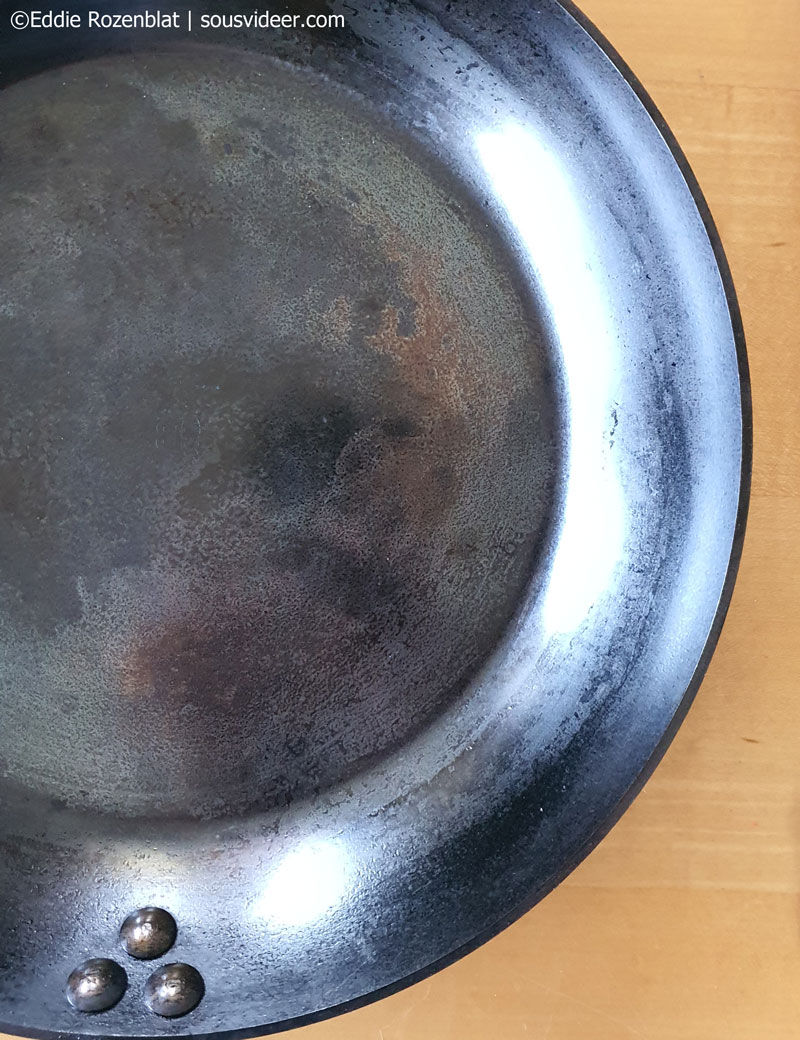
Over time, you'll see the pan start to change color, from silver to golden.
Turn off the heat and let the pan cool.
Don't expect a completely black pan after one round of seasoning - it's a long process that takes quite a few searing and seasoning sessions, and right now it's already ready to use.
The initial seasoning process, searing and cleaning after use
Initial seasoning of a cast iron pan
Surprisingly, most cast iron pans actually come pre-seasoned, meaning they're already coated and ready to use.
If your pan didn't come that way, simply follow the seasoning process detailed below.

How to season a cast iron or carbon steel pan
There are quite a few seasoning methods online, but in my opinion the following one is the easiest and quickest and gives good results.
Pour a small amount of oil (canola oil or seasoning wax) onto the pan.
Coat every bit of steel on the pan with the oil, inside and out.
Then (and this is the most important part of the story), wipe off all the remaining oil really well with paper towels or a dry towel, to the point where you can no longer see any oil.
In fact, a microscopic layer of oil will still remain, which will become part of the pan as it burns, creating the non-stick layer and also preventing the pan from rusting during long storage.
Turn the heat up to the highest setting and place the pan on top.
After a few minutes, you'll see smoke forming, which shows the thin layer of oil left on the pan is burning.
Once all the smoke is gone, leave the pan on high heat for a few more minutes.
Turn off the heat and let the pan come back to room temperature.
You can repeat this process after every use, although it's not a must.
How to clean a cast iron or carbon steel pan
I split the cleaning process into two categories:
Light dirt or a pan full of oil/fat residue - in this case, I pour salt onto the pan and wipe the whole dirty layer with paper or a kitchen towel. Scrubbing with the salt makes it absorb all the oil/fat residue and the dirt stuck to the pan.

Heavy dirt - in this case, I heat the pan a little, add some water and scrub well to remove all the residue and dirt stuck to the pan.

Then, run hot water in the sink, so you don't create an extreme temperature difference, which can make cast iron pans crack.
Quickly rinse the pan with a paper towel, clean any areas that are still dirty, and dry it well. You can use a little soap briefly to remove stubborn dirt.
You can season it again, but it's not a must.
If you choose to skip seasoning, it's important to dry the pan well, at least by heating it again on the stove.
A note on cleaning methods - beyond my personal recommendations for cleaning the pan, it's generally a good idea to check the manufacturer's website for the right way to clean it.
For example, de Buyer recommends pouring hot water on the pan (similar to deglazing) to scrape off food residue stuck to it.
Then, rinse with hot water and, if needed, use soap briefly.
"Mineral B and Blue Steel Pans: Once food is cooked, deglaze your pan by pouring some liquid onto it (wine, water…). After deglazing the pan, clean it with warm water. If residues remain, you should use an abrasive sponge. Dry the pan immediately and slightly oil it to avoid rust. Then, tidy it up in a dry place."
Things to keep in mind about cast iron and carbon steel pans
This is exposed steel, meaning you need to keep it away from water and dry it quickly.
These pans need a maintenance process of seasoning (coating) to keep the non-stick layer and prevent rust.
Steel pans are sensitive to acidic foods (for example, tomato sauce), which can eat away at the coating, so it's important to keep searing/frying times with acidic ingredients short.
Can you season a pan on induction?
I personally don't have an induction stove, but it was important for me to write about it, because it's a question that always comes up when buying a cast iron or carbon steel pan. According to comments online, seasoning can be slower (the heat concentrates in the center), so it's worth combining it with the oven.
What do I mean by the oven? After coating the pan with the layer of oil and wiping it off, put it upside down in the oven for an hour at 200°C (390°F).
Also, it's important not to turn the induction straight up to maximum, but to raise it gradually, and maybe not even all the way to maximum. A sudden change in heat can warp the steel (and cast iron pans can even shatter) and also make the pan "dance" on the stove.
I highly recommend checking the manufacturer's position on induction use before buying the pan.

Recommended pans
de Buyer Mineral B pan, 28 cm
Amazon Germany (the cheapest when this guide was published) https://amzn.to/30NFkBF
Amazon US https://link.amazon/B04Q5Ng4a
Amazon UK https://amzn.to/3jNwr2q
de Buyer Mineral B Pro pan, 28 cm
Lodge cast iron pan, 26 cm
Matfer pan, 28 cm
Accessories for cast iron and carbon steel pans
Polycarbonate pan scraper
Pan scrubbing pad
Seasoning wax
Frequently asked questions
How often should I season my pan?
You can season it after every use, but it's not a must. If you skip it, make sure to dry the pan well by heating it on the stove.
Can I use soap on cast iron or carbon steel?
Yes, a little soap for a short time to remove stubborn dirt, then rinse and dry the pan well.
Why isn't my new carbon steel pan black?
One round of seasoning won't make it black. The pan gets darker gradually with searing and seasoning.
Which oil should I use for seasoning?
A small amount of canola oil or seasoning wax.


Comments