


Inkbird ISV-100W Sous Vide Review

In short: the Inkbird ISV-100W is one of the cheapest sous vide devices I've worked with (around NIS 220-350). It's quiet, accurate and has Wi-Fi and an app, but it's big, its build quality is basic and its manual interface feels outdated. Great value for beginners or as a backup device.
The Inkbird ISV-100W sous vide device is the first device from the Chinese company Inkbird, which specializes in making thermometers.
I usually avoid working with devices from Chinese companies or white-label products because of the uncertainty around the quality control the device goes through before it reaches us, but I decided to give a chance to a company like Inkbird, which is known for the quality of its devices.
At first glance, the device seems to be a very pleasant surprise.
Inkbird ISV-100W specifications
Power | 1000W |
Temperature range | 25-99°C (77-210°F) |
Water capacity | Up to 15 liters per the manufacturer Up to 22 liters with a closed lid, per my own test |
Connectivity | Wi-Fi - control from outside the house |
Clamp | Fixed |
Water resistance | No rating |
Cylinder diameter | 60 mm |
Weight | 1.45 kg |
Accuracy | Up to 0.1°C |
Height | 42 cm |
Minimum water level | 7 cm |
Maximum water level | 16 cm |
Disassembly and cleaning | The whole metal part comes apart and is easy to maintain |
Manual control | Very bright LCD screen, very noticeable at night You can fully control the device manually, but it's less convenient than the app |
App | A basic app. The recipes are lacking, with no information on cooking time by thickness. |
Heating 10 liters from 25°C to 55°C | 30:30 minutes |
Heating 10 liters from 25°C to 82°C | Exactly one hour |
First impressions
The device is mainly sold on AliExpress (preferably from the company's official store), which raised my concerns about delivery time and using the warranty if I ever needed it, but surprisingly, the device arrived in less than two weeks.
I opened the box (which looked pretty basic) and found a fairly large device; the build quality looked pretty basic, and the display looked a bit outdated.
I took the device out, connected a proper grounded adapter and plugged it in - I strongly recommend not using the device without grounding, which is why I made a dedicated guide on it.
It took me a while to figure out how to operate the device manually - it's not that it's super complicated, I'm just used to the much simpler user interface of Anova devices, but that's what the app is for, letting you control the device even when you're away from home.
I immediately connected the device to the app and to the Wi-Fi network so I could control it from outside the house, and from then on, controlling it was very simple.
From that moment, the device went into intensive use for a month and a half to see whether it's worth buying and, most importantly, whether it's accurate and reliable.
Impressions after intensive use
After intensive use for over a month and a half, it turns out to be a device that meets quite a few expectations.
At first, I started with small cuts and short cooking times, with up to 10 liters of water.
Then I moved up to high temperatures of 75-85°C (167-185°F) with up to 15 liters of water.
Although it took the device quite a while to reach 85°C (heating times similar to the Anova Nano), you can shorten this by adding boiling water from the kettle.
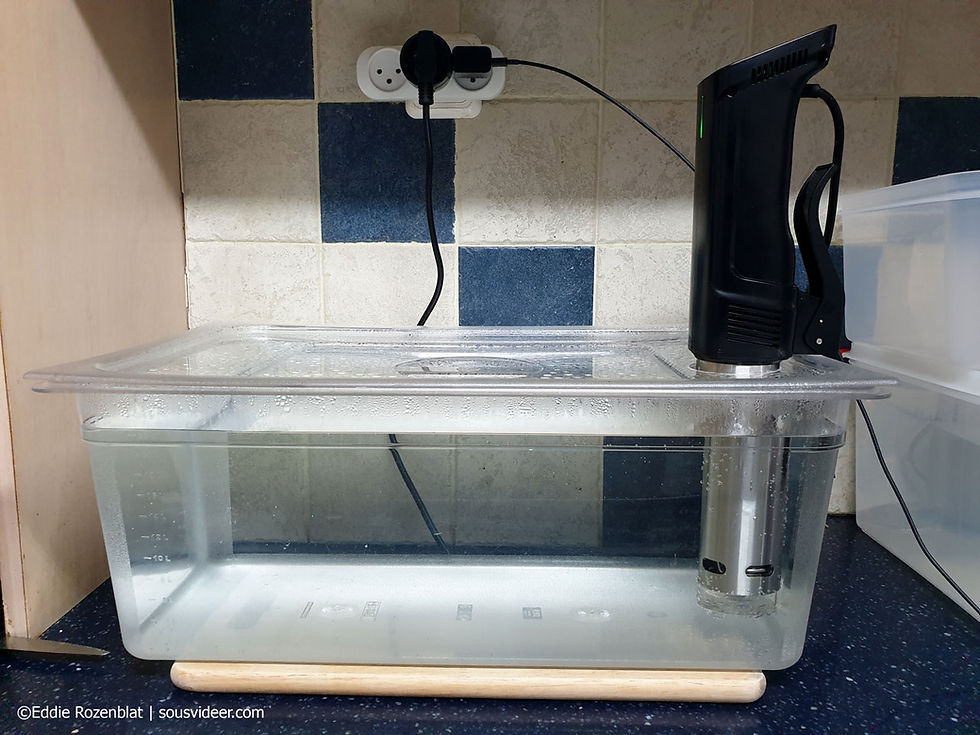
The last challenge was to see how the device performs beyond its 15-liter limit, and indeed, with a closed lid, the device had no problem heating and keeping an even temperature and circulation at every point in the container, to the point where I was cooking a leg of lamb and long spare ribs at full capacity at 75-85°C for a long time.
On the one hand, the device comes across as a large device with basic build quality and relatively long water heating times (like the Anova Nano), but on the other hand, the device delivers on the manufacturer's promises and even beyond - it's quiet, accurate and gives the same result as other, more expensive devices on the market.
Even though it's a very cheap device (between NIS 220-350), Inkbird provided a device with Wi-Fi for control from outside the house and an app that gives you full control of the device and alerts you when the device stops working due to a lack of water or when the set time is up (not the end of cooking, of course).
The app's recipes are still lacking, so I'd use other sources, but you can save recipes in it for future use.
Another important thing to note about the end-of-cooking alert - once you press confirm, the device stops working, so if you're not going to take the meat out right away, it's important to leave it on, especially when you're away from home, for food safety reasons.
Inkbird ISV-100W pros
The device is insanely quiet, to the point where sometimes you need to get close to it to hear it working. Luckily, there's an indicator light showing the device's status (green = working).
A dedicated app with full control and the option to save recipes.
Remote control from outside the house - you get alerts when the device stops working, which can be caused by a lack of water or a power outage.
A market-breaking price - sold at the lowest price of any device I've worked with so far, and it gives the same result as expensive devices, up to the device's water capacity limits.
Inkbird ISV-100W cons
A fixed clamp - something I personally don't like on any sous vide device, and in my opinion it's limiting when working with pots/containers. Here too, I had trouble working with a full-size polycarbonate container, so I needed some tools to cut the lid.
An outdated interface and user experience, which made me always prefer using the app over changing the cooking settings manually
One of the biggest devices I've worked with, with basic build quality
No water-resistance rating, so it's important to keep the device away from steam.
Service and warranty
Inkbird provides a 12-month warranty on the device, but that's something I haven't had a chance to check yet, so I'll update if I ever need to use the warranty.
Is the Inkbird ISV-100W worth it?
After intensive use for over a month, I must say that in my eyes this device is the best value for money, meaning it's worth every shekel of the roughly NIS 250 it cost, and from experience, that's the lowest price for a sous vide device.
Its build quality may not match devices like Anova or Joule, and the device looks much bigger and clunkier, but at the end of the day, it will cook with the same settings in exactly the same way (up to its water capacity limits) as the other, more expensive devices, so for anyone looking for a device to try sous vide, anyone who's not yet sold on this cooking method, or anyone looking for a backup device, it's definitely a cheap and great option.


Frequently asked questions
Is the Inkbird ISV-100W accurate?
Yes. After a month and a half of intensive use, it gave the same results as more expensive devices, up to its water capacity limits.
How much water can the Inkbird ISV-100W heat?
It's rated for up to 15 liters, but with a closed lid it had no problem with a full 22-liter container at 75-85°C.
Does the Inkbird ISV-100W have Wi-Fi?
Yes. You can control it with the Inkbird app, even from outside the house, and get alerts when the device stops working.
What warranty does Inkbird provide?
Inkbird provides a 12-month warranty on the device.


Comments